Why Seek Rebirth in Amitabha's Pure Land Instead of Maitreya's Tusita Heaven?
The following article is adapted from Master Zhiyi's Ten Doubts About the Pure Land (《净土十疑论》).
Master Zhiyi (538–597), also known as Master Zhizhe, was the founder of the Tiantai School of Chinese Buddhism. In the Chinese Buddhist tradition, he is widely revered as an emanation of Śākyamuni Buddha. Although he established the Tiantai tradition, he also deeply upheld the Pure Land teachings and, before his passing, vowed to be reborn in Amitābha Buddha's Land of Ultimate Bliss (Sukhāvatī).
In this passage, Master Zhiyi addresses a common question: If one can be reborn in Maitreya Bodhisattva's Tuṣita Heaven and meet Maitreya there, why should one instead aspire to rebirth in Amitābha Buddha's Western Pure Land?
His answer compares the two destinations and explains, from the perspective of Pure Land Buddhism, why rebirth in Amitābha's Pure Land offers the surer path to non-retrogression and ultimately to Buddhahood.
Question:
Maitreya Bodhisattva is destined to attain Buddhahood in one more lifetime (eka-jāti-pratibaddha, "one lifetime remaining"). Those who cultivate the highest level of the Ten Wholesome Deeds can be reborn in the Tuṣita Heaven, where they may see Maitreya Bodhisattva. They will then accompany him when he descends to the human world, attend the Three Assemblies beneath the Dragon Flower Tree, and naturally attain the holy fruits of liberation. Why, then, is there any need to aspire for rebirth in Amitābha Buddha's Western Pure Land?
Answer:
At first glance, being reborn in Tuṣita Heaven and hearing the Dharma directly from Maitreya Buddha may appear comparable to being reborn in the Western Pure Land. However, upon careful comparison, there are significant differences. Let us consider two points.
First Difference: The Difficulty of Rebirth
Even if one practices the Ten Wholesome Deeds perfectly, rebirth in Tuṣita Heaven is still not guaranteed. How do we know this?
The Sutra on Maitreya's Ascent to Tuṣita Heaven states:
"Only those who cultivate various samādhis and enter deeply into right concentration can be reborn there."
The sutra does not teach any special means by which Maitreya personally receives and guides beings to that realm.
This is unlike Amitābha Buddha, whose power of great vows and power of boundless light embrace all sentient beings who sincerely recite his Name, never abandoning them.
Moreover, Śākyamuni Buddha taught the Nine Grades of Rebirth as skillful means for receiving beings into the Pure Land, repeatedly encouraging and exhorting sentient beings to seek rebirth there.
Whenever beings sincerely recite Amitābha Buddha's Name, the corresponding connection between the practitioner and Amitābha's compassionate vows is established, and rebirth is assured.
It is like two people in the world who mutually admire one another: when the conditions are in harmony, their aspirations naturally come to fulfillment.
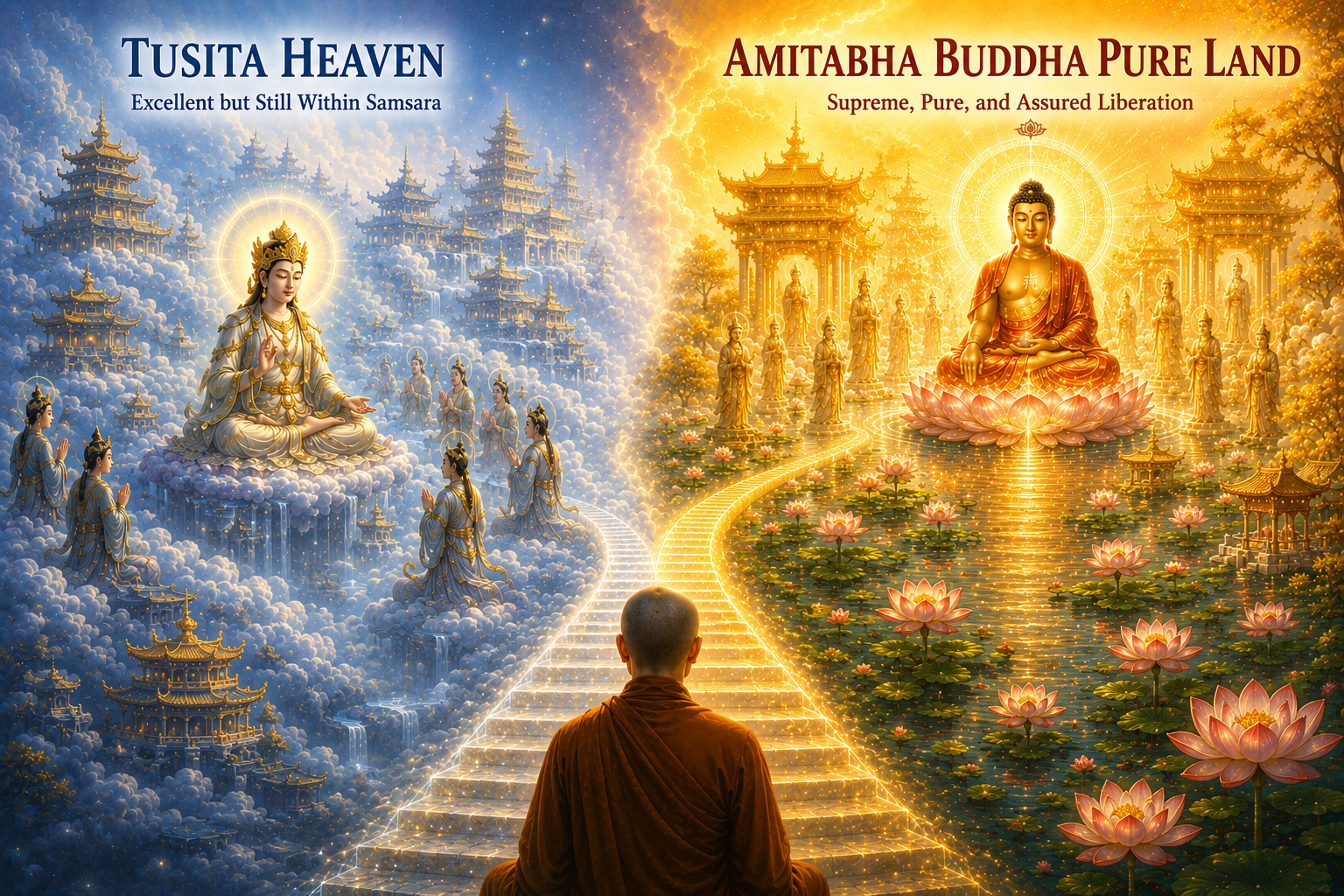
Second Difference: The Environment of Tuṣita and the Pure Land
Although Tuṣita Heaven is an excellent realm, it still belongs to the Realm of Desire (Kāmadhātu). Therefore, there remains the possibility of spiritual regression. There are no jeweled ponds, birds, forests, or Dharma sounds like those of Amitābha's Pure Land, whose voices constantly inspire beings to:
Recollect the Buddha,
Arouse Bodhicitta,
Subdue afflictions, and
Cultivate enlightenment.
Furthermore, Tuṣita Heaven still contains celestial maidens, and heavenly beings continue to possess attachment to the pleasures of the five desires. The exquisite enjoyments of the heavenly realm easily captivate its inhabitants, making diligent cultivation more difficult. By contrast, in Amitābha's Pure Land; the waters, birds, forests, breezes, and every sound all proclaim the Dharma, inspiring all beings to recollect the Buddha, generate Bodhicitta, and eliminate afflictions.
There are no women and no practitioners of the Two Vehicles (all beings after being born are Bodhisattvas). All companions are pure Mahāyāna Bodhisattvas. Therefore, afflictions and evil karma never arise again, and practitioners ultimately attain the stage of Non-arising (Anutpattika-dharma-kṣānti, the Endurance with the Non-arising of Dharmas).
When compared in this way, the superiority and inferiority of the two realms become perfectly clear. There is no reason for doubt.
Even Seeing a Buddha Does Not Guarantee Liberation
Even during the lifetime of Śākyamuni Buddha, countless beings—as numerous as the sands of the Ganges—personally saw the Buddha yet failed to attain the holy fruits. The same will be true when Maitreya Buddha appears in the future: many beings will still fail to attain liberation.
This differs greatly from Amitābha's Pure Land.
Once one is reborn there, one immediately attains the Endurance with the Non-arising of Dharmas, and not a single person ever falls back into the Three Realms or is bound again by the karma of birth and death.
The Story of Asaṅga, Vasubandhu, and Śiṃhabhadra
It is also recorded in the Indian Buddhist tradition that there were three great Bodhisattvas: Asaṅga (无住),Vasubandhu (天亲)and Śiṃhabhadra (狮子觉 Shizijue). All three made a vow together to be reborn in Tuṣita Heaven to see Maitreya Bodhisattva.
They agreed that whoever arrived first would return and report to the others.
Śiṃhabhadra passed away first. Many years passed, yet he never returned.
Later, when Vasubandhu was approaching death, Asaṅga said to him: "Once you have seen Maitreya Bodhisattva, come back immediately and tell me."
Three years after Vasubandhu's passing, he finally appeared.
Asaṅga asked, "Why did it take you so long to return?"
Vasubandhu replied, "After arriving in Tuṣita Heaven, I attended a single Dharma assembly given by Maitreya Bodhisattva. After circumambulating him once, I came back immediately to fulfill our promise. However, because one day in Tuṣita Heaven is exceedingly long, three years had already passed in the human world."
Asaṅga then asked, "Where is Śiṃhabhadra now?"
Vasubandhu replied, "Śiṃhabhadra became absorbed in the heavenly pleasures and the delights of the five desires. He now dwells among Tustita's outer retinue. Since his rebirth there, he has not yet even had the opportunity to meet Maitreya Bodhisattva."
(Note: Vasubandhu is the author of the Rebirth Treatise)
Conclusion
If even junior Bodhisattvas who are reborn in Tuṣita Heaven can still become attached to heavenly pleasures and the five desires, how much more so ordinary beings? For this reason, it is preferable to aspire for rebirth in Amitābha Buddha's Western Pure Land, where one is assured of non-retrogression on the path to Buddhahood.
Therefore, one should seek rebirth in the Western Pure Land rather than in Tuṣita Heaven.
Notes
l One Lifetime Remaining (一生补处): The stage of a Bodhisattva who is destined to become a Buddha in the very next lifetime. Maitreya Bodhisattva is the classic example.
l Three Assemblies beneath the Dragon Flower Tree (龙华三会): The three great Dharma assemblies that Maitreya Buddha is prophesied to hold after descending into the human world.
l Patience with the Non-arising of Dharmas (无生法忍): An advanced Bodhisattva realization in which one directly realizes the unborn nature of all phenomena, a stage from which there is no regression toward saṃsāra.
l Five Desires (五欲): The pleasures associated with sights, sounds, smells, tastes, and tactile sensations, which can become objects of attachment even in the heavenly realms.
答:求生兜率,一日闻道见佛,势欲相似。若细比校大有优劣,且论二种。
一者纵持十善恐不得生,何以得知?弥勒上生经云:‘行众三昧,深入正定,方始得生。’更无方便接引之义。不如阿弥陀佛本愿力、光明力,但有念佛众生,摄取不舍。又释迦佛说九品教门方便接引,殷勤发遣生彼净土。但众生能念弥陀佛者,机感相应必得生也。如世间慕人能受慕者,机会相投必成其事。
二者兜率天宫是欲界,退位者多。无有水鸟树林风声乐响,众生闻者,悉念佛发菩提心伏灭烦恼,又有女人皆长诸天爱著五欲之心。又天女微妙诸天耽玩不能自勉,不如弥陀净土水鸟树林风声乐响,众生闻者,皆生念佛发菩提心伏灭烦恼。又无女人二乘之心,纯一大乘清净良伴。为此烦恼恶业毕竟不起,遂至无生之位。如此比校,优劣显然,何须致疑也。
如释迦佛在世之时,大有众生见佛不得圣果者如恒沙。弥勒出世亦尔,大有不得圣果者。未如弥陀净土,但生彼国已,悉得无生法忍,未有一人退落三界,为生死业缚也。
又闻西国传云,有三菩萨,一名无著,二名世亲,三名师子觉。此三人契志同生兜率愿见弥勒,若先亡者得见弥勒誓来相报。师子觉前亡,一去数年不来,后世亲无常,临终之时无著语云:‘汝见弥勒即来相报。’世亲去已三年始来。
无著问曰:‘何意如许多时始来?’
世亲报云:‘至彼天中,听弥勒菩萨一坐说法,旋绕即来相报。为彼天日长故,此处已经三年。’
又问:‘师子觉今在何处?’
世亲报云:‘师子觉为受天乐,五欲自娱在外眷属,从去已来总不见弥勒。’
诸小菩萨生彼尚著五欲,何况凡夫?为此愿生西方定得不退,不求生兜率也。
- From Master Zhiyi, Ten Doubts About the Pure Land
智者大师《净土十疑论》
Namo Amitabha Buddha 🪷🙏
Namo Amituofo 🪷🙏